The 2026 Guiding for the Future (G4F) course is set for March 10 through 12! The Fishing Outfitters Association of Montana’s (FOAM’s) advanced guide-training program. G4F is a voluntary course of study and evaluation to elevate the expertise and professionalism of fishing guides and outfitters.
The 2026 G4F program will be held on the Bighorn River, March 10th through the 12th! The timeline for the 2026 class consists of:
Online course. Starting in January, the class list will be merged into the online portal and open for you to begin this portion of the program. New students will have plenty of time to get this completed before the practicum in March.
January through March 2026. Keeping with the hybrid teaching model adopted during COVID, we will be holding Zoom meetings with instructors. These sessions will be covering topics necessary for your participation at the March Practicum.
March 10-12. The G4F practicum will be held in the on the Bighorn River.
Class size is limited. G4F student preference is given to individuals holding a valid Montana outfitter or guide license with at least three years’ guiding experience. To apply for next year’s course, please fill out the application on the Guiding for the Future website .
The mission of G4F is to develop a dedicated stewardship of aquatic ecosystems while increasing knowledge, professionalism, and ethics of fishing guides, outfitters, and the fly-fishing industry throughout Montana. Led by FOAM and a Steering Committee comprised of representatives from the fly-fishing industry, aquatic conservation community, and other professions, this program serves as a new continuing education program for fishing guides in the state of Montana.
The 2026 G4F program will again be taught online in a webinar-style presentation with the field-portions of the practicum will be taught hands-on through small in-person gatherings. Participants will be evaluated and tested on their knowledge and performance. Successful completion of this course will provide participating guides, outfitters, and fly shops with a set of credentials that will distinguish graduates to outfitters, clients, other river users, and agencies.
Hope to see you there, enroll for next year’s G4F today!
Guiding for the Future (G4F), borne from the challenges of outfitting during the 2016 closure of 183 miles of the Yellowstone River, is a program that provides advanced levels of knowledge and skill development for professional fishing guides and outfitters across Montana. The program’s goal is to enhance the dedicated stewardship of aquatic ecosystems while increasing knowledge, professionalism, and ethics of fishing guides, outfitters, and the fly-fishing industry.
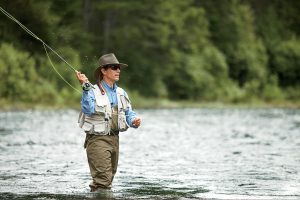
G4F first met Macauley Lord at the Maine G4F course in 2023. We are excited to announce that Macauley will be coming to Montana to help instruct casting at the 2026 G4F practicum on the Bighorn River in March.
Macauley Lord trains and certifies casting instructors for the Federation of Fly Fishers and is head instructor at the L.L. Bean Fly Fishing Schools.
Macauley Lord received the Lifetime Achievement Award from the Casting Board of Governors of Fly Fishers International (FFI) in 2011. It is the highest honor in the worldwide field of fly-casting instruction.
He has taught at the L.L. Bean Fly Fishing Schools since 1986. He was the Head Instructor of the L.L. Bean Schools from 1996 until 2008. He is a Registered Maine Fishing Guide.
He was the fly-casting columnist and a contributing writer for American Angler magazine from 2000 until 2009. His articles have also appeared in Fly Fisherman, Saltwater Fly Fishing and Architecture Boston. As an emeritus member of the Casting Board of Governors and a Master Flycasting Instructor, he trains and certifies fly casting instructors around the country. He served on the Board’s Executive Committee for many years and was twice the Editor of The Loop, the FFI’s quarterly journal of casting instruction. He has fished extensively in the American West and in Argentina, fishing the great rivers of the hemisphere from a float tube.
A graduate of Bowdoin College and Bangor Theological Seminary, he is a Licensed Eucharistic Minister in the Episcopal Diocese of Maine. He volunteers as a chaplain at his 500-inmate county jail. He also serves as a chaplain and fly-fishing instructor to Discover Courage, an organization that helps active-duty and retired Navy SEALs by teaching them to fly-fish.
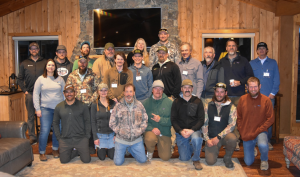
Our G4F program is centered around compartmentalized learning modules. Online, you can work on whichever module you like, then move on. At the practicum, we take an in-depth dive into some of the modules that require a classroom approach and a field exercise.
History of Fish and Wildlife Conservation.
This module is taught online and is intended to give the student a sense of how wildlife laws and regulations emerged in medieval Europe, evolved in Colonial America, and continued to evolve and expand into today’s system of laws, regulations, and practices. It provides a background on the establishment of laws, the individuals who championed the effort, and specific examples of the look and feel of conservation.
This module was authored by Whitney Tilt. Throughout his career Whitney has focused on natural resource conservation issues, working to identify common ground, and sustainable solutions. Whitney has worked for the Arthur M. Blank Family Foundation, National Fish and Wildlife Foundation, and the Sonoran Institute, among others. Alec Underwood contributed to this module. Alec brings his passion for conservation and admiration of public lands to the job. He has spent several years in the field of fisheries and holds a degree in aquatic wildlife biology from the University of Montana.
Laws & Regulations, Stream Access, and Aquatic Invasive Species.
This module covers Laws & Regulations, Stream Access, and Aquatic Invasive Species. It is intended to give the student a working knowledge of general laws and regulations governing fishing, stream access and trespass, laws and regulations governing outfitters and guides, and aquatic invasive species (AIS).
The online material was assembled by several members of the G4F Steering Committee and reviewed for accuracy by members of Fish, Wildlife & Parks (FWP) FWP Division of Law Enforcement. AIS is also presented as classroom lecture during the practicum.
Outdoor Ethics and Etiquette.
The Outdoor Ethics and Etiquette module is intended to give the student a background in the development of outdoor ethics and introduction to river etiquette. The module also has a situational ethics component where students are expected to interact with other students and instructors online addressing a series of scenarios where a balance of ethics and etiquette are at play. The information presented in this online module, together with the online scenario discussions are continued during the hands-on practicum, which will include a panel discussion with FWP, riparian landowners, and others.
Dave Kumlien has been the lead instructor for this module, a 45-year Montana guide and outfitter number 281 for Montana Troutfitters in Bozeman (est. 1978). Dave has long been active in outfitter and conservation issues. In 2001, he received the Outdoor Life Magazine Conservationist of the Year award. A founding director and first President of Fishing Outfitters Association of Montana (FOAM), he has served on the Board of Directors of the Madison-Gallatin Chapter of Trout Unlimited and the Montana TU State Council. At some practicums, this module is led by some members of the FOAM board of directors.
Hydrology and River Ecology.
The Hydrology and River Ecology module is intended to give the student an introduction to hydrology and the forces that shape our rivers and aquatic systems. The foundational content provided online is reinforced and built upon at the practicum that includes classroom and field learning.
The lead instructor for this module is Mike Sanctuary. Mike is Senior Project Manager, Vice President, Confluence Consulting, Inc. in Bozeman, MT. As Senior Project Manager, Mike leads a multi-disciplinary team of stream ecologists, wetland scientists, engineers, and biological technicians. Mike is proficient in watershed scale assessments, stream restoration design and construction services, and complex project management. Mike has 15 years’ experience in environmental consulting and has worked with Federal and State agencies, many watershed groups, non-profit organizations, Native American Tribes, and private landowners to restore and protect aquatic habitat.
Water Use and Challenges in Montana.
The Water Use and Challenges in Montana module is intended to give the student a working knowledge of hydrology as it affects water supply, groundwater and surface waters, how water is used in Montana, and the challenges faced in managing our water supply.
The instructor for this module has been Michael Downey. Michael is the Water Planning Section Supervisor with the Montana Department of Natural Resources and Conservation (DNRC). He currently spends much of his time watching the weather and parsing climate data in support of the Governor’s Drought and Water Supply Advisory Committee.
Fish Ecology.
The Fish Ecology module is intended to give the student a working knowledge of fish anatomy, their life in water, and how fish interact with their surrounding environment. In addition, the module introduces fisheries assessment and the science of fish handling.
The instructor for this module is Sascha Clark Danylchuk, Executive Director, Keep Fish Wet, Amherst, MA. As a fisheries scientist, Sascha has focused most of her work on recreational angling, specifically the science of catch-and-release. She has also worked for a handful of non-profit organizations putting conservation into practice. It is the intersection between her work as a scientist and her passion as an angler that led Sascha to Keep Fish Wet. With a belief that recreational anglers have something to learn from fisheries scientists and that scientists need to make their work accessible to a wider audience, Sascha endeavors to develop a space in which everyone can communicate more directly and in a language that can be understood by all.
Ecology of Aquatic Insects.
Much of a fishing guide’s efforts are focused on convincing trout you are presenting an aquatic insect. The Ecology of Aquatic Insects module provides a background on the life history, habits, and behaviors of aquatic insects, particularly macroinvertebrates. The content covers, basic anatomy, aquatic insect orders, feeding habitats and many other topics of importance. This course began as an introduction to fly fishing entomology course that was taught at the Hyde Outfitters Guide School in Island Park, Idaho in spring of 1999. The course was always a classroom portion followed by a field portion. The online portion of this course was developed to provide the student with an introduction to, and concepts of, aquatic entomology, ecology, and their integration to begin to understand the importance of aquatic entomology to conservation. The goal of this entire course is to have the student begin thinking ecologically about conservation – understanding the interconnectedness of the physical environments and their influence and impacts on the communities of organisms they effect.
The lead instructor for this module is Mike Bias, Executive Director, FOAM, Twin Bridges, MT. Mike brings with him an extensive background in conservation, which makes his advocacy with agencies, legislators, and the public especially valuable. A Montana outfitter and Idaho guide, Mike spends some of his time during the summers guiding out of Island Park, Idaho. In addition to his work with FOAM, Mike serves as the Principal Ecologist for EcoSystems, LLC, his own environmental consulting company. Mike earned his Ph.D. from the University of California, specializing in population and habitat ecology. Bias also has an MS and a BS, both in Wildlife Science.
Guides as Stewards.
G4F is not about landing the most or biggest fish, but rather inspiring dedicated stewardship of aquatic ecosystems while increasing the knowledge and professionalism of guides, outfitters, and the fly-fishing industry. The Guides as Stewards module introduces the student to three distinct areas related to natural resource stewardship: 1) how to become an effective advocate for the resource, 2) general principles of data collection, and 3) collection and assessment techniques.
Instructors for this module were David Brooks, Executive Director, Montana Trout, Missoula, MT. David served as Montana TU’s Conservation Director before taking the position as Executive Director in May, 2017. He looks forward to applying his background as an environmental historian studying Superfund sites and watershed issues to MTU’s current and future mission of conserving and restoring the state’s coldwater fisheries. As part of earning his PhD in history at the University of Montana, David wrote the book on Superfund cleanup of the Milltown Dam site on the Clark Fork. Alec Underwood Also contributed to this module.
Beyond Flies and Drifts.
Guiding has always been about giving the client a first-class experience on the water. For many experienced fishermen that translates into putting them on fish and letting them do the rest—lunch is optional and can consist of a PB&J made yesterday. But for many other clients, and market research suggests a growing segment, the experience for the client goes beyond fly selection and sharing nuances of drifts—it is about the food, the conversation about local birdlife, and about getting a total novice to enjoy the zen of fly-casting.
The Beyond Flies and Drifts module offers the students a strong background into the mechanics of fly casting and how to teach it. This module speaks to the importance of equipment and provides several educational resources for understanding the fish, wildlife, wildflowers, and geology of the region. Many students likely know some or all of it. Some students may have been accused of “making it up.” Now collectively G4F is seeking to build an online library of resources and references that guides can use to become better guides for their clients. The fly-casting content provided online will be reinforced and built upon at the hands-on practicum all each student is asked to engage in an online discussion on ways to make your client’s trip exceptional.
Lead Instructors for this module are Brant Oswald, G4F Co-Founder; and Jamie Lyle, Representative for Orvis. A past contributor to this module has been Bruce Richards (instructor at practicum), Instructor, Fly Fishers International, Ennis, MT.
Brant Oswald, Fly fishing outfitter and guide, Livingston, MT, has worked in nearly every segment of the fly-fishing industry—as a fishing school instructor/director, fishing travel consultant, fly shop manager, and casting instructor. Brant has written extensively for fly fishing periodicals, and he now contributes regularly online. Brant has been active with conservation groups, including CalTrout, the Joe Brooks (Livingston, MT) Chapter of Trout Unlimited, and the Park County Environmental Council, and he served on the Governor’s Upper Yellowstone River Task Force from 1997 to 2003. He currently serves on the board of the Invasive Species Action Network and as a senior advisor to the board of the FOAM.
Montana Conservation.
The Montana Conservation module is intended to help students develop an understanding of the history of wild trout management in Montana, stream access and water laws, how fish and wildlife laws and regulations are made, and the process of stream permitting and reporting of fish and wildlife law violations. Students will be expected to read content and stream videos from several sources to learn about these topics. Students will build upon their knowledge of these issues in the Conservation Module during Module 8—Guides as Stewards. Bill Pfeiffer, Outreach Coordinator, Montana Trout Unlimited, leads and has contributed to greatly to this module.
For all information on FOAM’s Guiding for the Future program, including how to apply, visit guidingforthefuture.org.