Blog

FOAMLine, Vol. 35, No. 2, April 2026

IN THIS ISSUE:

2026 FOAM Annual Meeting – Wrap Up!

2026 Guiding for the Future – Warp Up!

G4F Goes to Wyoming

Hardy Party – 2026 Season Kick Off

Big Hole River BLM Permits

FOAM at the EQC

FOAM 2026 Annual Meeting - Wrap Up!

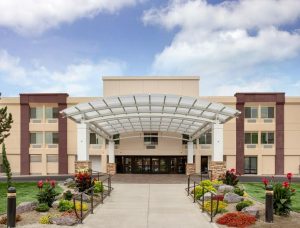
This year’s Fishing Outfitters Association of Montana (FOAM) Annual Membership Meeting held on March 7 at the Holiday Inn Downtown Missoula was a huge success, with over 120 guides, outfitters, vendors, and guests attending.

We had two new Board of Directors –  Ryan Barba, representing the Beaverhead/Big Hole region, and Peter Holman, our new East Side Guide-at-Large –  attending their first Annual Meeting as board members.

Presentations were outstanding with a slate of excellent speakers, including:

  • A Statewide State of the Fishery Report from FWP Fisheries Administrator Adam Strainer
  • A report on Bull Trout trends in the Bob Marshall Wilderness Complex from Region 1 Fisheries Biologist Leo Rosenthal
  • An update on Guiding for the Future from Director Russell Parks
  • A Region 2 State of the Fishery Report from Fisheries Program Manager Pat Saffel
  • Insights into leveraging technology in guiding businesses from Brindlechute founder Connor Lanman
  • An update on Lower Clark Fork trout population trends from Region 1 Fisheries Biologist Jason Blakney
  • An overview of Water Trends Affecting Montana Fisheries from MSU Assistant Professor Dr. Tim Cline
  • The always-riveting FOAM Annual Report from our Executive Director, Mike Bias
  • And a closing panel discussion on water and water trends statewide, fittingly titled “The 800-Pound Gorilla in the Room” with panelists Pat Saffel (MT FWP), Dr. Tim Cline (MSU), Pedro Marques (Big Hole Watershed Committee), and Pat Byorth (TU and former Fish & Wildlife commission member).

At our expanded Vendor Event, we were thrilled to once again be joined by a fantastic group of industry partners, including Trxstle, Oros, Simms, RioCraft, Trout Routes, Free Fly, Yellow Dog, Montana Fly Company, Montana Whiskey Co., All Rod, Riversmith, NRS, Brindlechute, and more.

We raffled some exceptional items, including a Simms G3 Outfit (waders, jacket, and boots), a Trxstle rod holder, apparel from Free Fly, subscriptions from Brindlechute and Trout Routes, Blackfoot Bourbon from Montana Whiskey Co., and many additional items donated by supporting fly shops, breweries, retailers, and restaurants.

Between presentations, we had plenty of time to visit vendor booths, purchase raffle tickets, and enjoy complimentary lunch, post-meeting snacks, and Lewis and Clark Brewing Company beer, generously provided by our friends at Brindlechute.

The day concluded with our own Brant Oswald winning the 2026 RioCraft Madison Raft and Montana Raft Frames trailer.

With the great success of this year’s event, we are already planning next year’s FOAM Annual Meeting.  We are deeply appreciative of your attendance and vendor support, which reflects a shared recognition of the important work FOAM does year-round to advocate for our members and provide a professional voice for our industry.

Thank you for your continued membership and for trusting this board to represent your best interests as we navigate the challenges facing our industry.   We look forward to seeing you all at next year’s Annual Meeting.
2026 Guiding for the Future - Wrap Up!

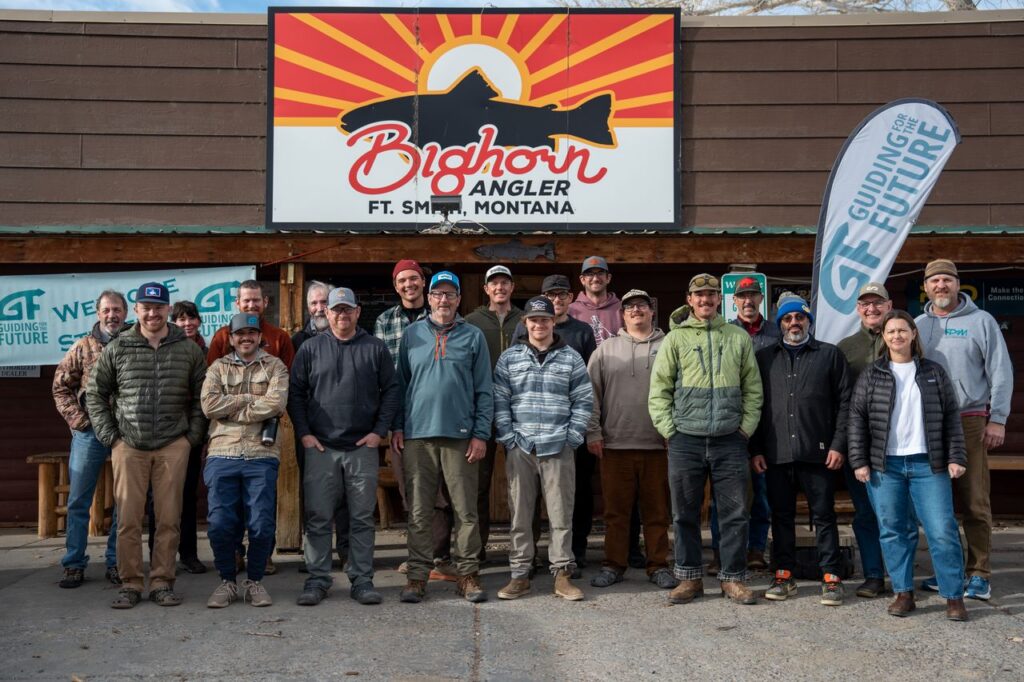
At the conclusion of the 2026 G4F Practicum in Ft. Smith, we now have 12 new G4F Ambassadors.  Online course analytics show an average of 1,478 page views and 96 total visits, with an average final course grade of 90.  We now have over 100 G4F Ambassadors.

The 2026 Guiding for the Future (G4F) course was held March 10 through 12 on the Bighorn River.  The Fishing Outfitters Association of Montana’s (FOAM’s) advanced guide-training program, G4F is a voluntary course of study and evaluation to elevate the expertise and professionalism of fishing guides and outfitters. 

The mission of G4F is to develop a dedicated stewardship of aquatic ecosystems while increasing knowledge, professionalism, and ethics of fishing guides, outfitters, and the fly-fishing industry throughout Montana.  Led by FOAM and a Steering Committee comprised of representatives from the fly-fishing industry, aquatic conservation community, and other professions, this program serves as a new continuing education program for fishing guides in the state of Montana. 

The 2027 G4F program will again be taught online in a webinar-style presentation with the field-portions of the practicum will be taught hands-on through small in-person gatherings along the Bitterroot River.  Participants will be evaluated and tested on their knowledge and performance.  Successful completion of this course will provide participating guides, outfitters, and fly shops with a set of credentials that will distinguish graduates to outfitters, clients, other river users, and agencies.

Hope to see you there, enroll for 2027’s G4F today!

G4F Goes to Wyoming!

The Jay Kemmerer Wyoming Outdoor Recreation, Tourism and Hospitality (WORTH) Institute at the University of Wyoming has partnered with Wyoming fishing guides and the Fishing Outfitters Association of Montana to support the inaugural delivery of an advanced fishing guide certification course tailored specifically to Wyoming’s rivers, regulations and guiding traditions.

The Fishing Outfitters Association of Montana currently offers “Guiding for the Future,” an intensive professional development program for Montana outfitters and fishing guides that blends self-paced online coursework with an in-person, on-the-water practicum. Recognized for its depth and rigor, the program emphasizes conservation history, regulations, ethics, hydrology, river ecology and professional guiding standards.

Wyoming-based outfitters Mike Dawes and AJ Sanders — both longtime guide company owners and instructors — saw an opportunity to adapt the program for Wyoming’s unique fisheries and regulatory environment. Sanders, owner of Wyoming Angling Co., and Dawes, one of the owners of Westbank Anglers, worked together for decades running the Western Rivers Guide School, which Sanders continues to lead today. Both are based in Jackson.

“Wyoming has some of the most iconic fisheries in the country, but our guides haven’t had access to an advanced, Wyoming-specific professional certification,” Sanders says. “This partnership allows us to build on a proven model while making it truly relevant to the places and waters where we work.”

Dawes and Sanders partnered with the Jay Kemmerer WORTH Institute to adapt the existing “Guiding for the Future” curriculum to Wyoming’s rivers, laws, conservation frameworks and guiding culture. The collaboration resulted in the first cohort of Wyoming fishing guides enrolling in the adapted course, which will culminate in an in-person practical session on Wyoming waters this April.

This inaugural group of guides will play a key role in evaluating and refining the curriculum to ensure it meets the needs of Wyoming’s guiding community and can serve as a durable model for future cohorts.

“This course represents an important step in professionalizing fishing guide training in Wyoming,” Dawes says. “It’s about elevating standards, supporting stewardship and ensuring guides are equipped to deliver exceptional and responsible experiences.”

Once finalized, the program will offer an advanced certification for Wyoming fishing guides, helping strengthen workforce development, conservation ethics and visitor experiences statewide.

At the same time, Dan McCoy, director of the Jay Kemmerer WORTH Institute, notes that, while fishing guides play a critical role in public land stewardship, angler education and fisheries sustainability, the guiding profession lacks a nationally recognized framework for core competencies and curriculum standards.

“Other outdoor professions — such as avalanche education and professional trail building — have invested in clear competency standards and training pathways,” McCoy says. “Fishing guiding is ripe for the same kind of thoughtful professionalization.”

Building on this work, senior undergraduate students in UW’s Outdoor Recreation and Tourism Management Program will undertake a capstone research project examining fishing guide schools nationwide and how other outdoor industries have developed training standards. The project will produce a best-practices framework for fishing guide education, including core competencies, curriculum structure and recommendations for an organization to serve as a clearinghouse for guide training standards.
Hardy Season Kick-Off Celebration

Hardy recognizes that guides, outfitters, retail staff, and the people who shape local angling communities are the lifeblood of fly fishing. We also believe that Montana is one of the most important proving grounds in North America. With that in mind, we are pleased to invite you to the Hardy 2026 Season Kick-Off — an evening dedicated to the people who keep the culture of fly fishing moving forward.

Please join us for an invite-only evening with product designer Howard Croston and the Hardy team as we kick off the season with demonstrations, competition, and camaraderie. The full Hardy assortment will be on display, with demo casting opportunities throughout the evening, including a spotlight on the Marksman and a sneak peek at new products.  See event flyer. 

What to expect:

  • Explore the full Hardy assortment and demo our latest rods, including the Marksman
  • Hear from Howard Croston in two featured presentations:
    • 6:00pm — The Hardy Difference: Rod Design, Materials, and Development
    • 7:00pm — Hardy Evolution & Innovation: Split Cane to Sintrix, Perfects to Performance Reels
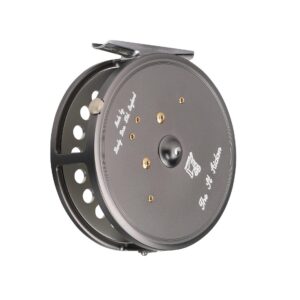
  • Test your casting skills in our evening casting competition, with prizes awarded to the top three finishers — including a Hardy Perfect for 1st place
    • Competition ends at 8:00pm
  • Enjoy Hardy gifts and free beer and food with fellow industry friends
  • Enter for the chance to win one of 50 Hardy rods in an evening drawing — RSVP by 3/30 is required to be eligible

This is an invite-only gathering, so secure your spot today — RSVP here 

Where:  Trout Chasers Lodge, 77017 Gallatin Rd., Bozeman, MT 59718

When:  April 3rd, 2026,  4:00pm – 8:30pm

We look forward to seeing you there.
BLM Big Hole Permits Required

Who needs a Special Recreation Permit? 

A Special Recreation Permit (SRP) is an authorization that allows certain recreational uses of public lands and waters.  Any commercial use of BLM lands requires an SRP, including river shuttles, guided fishing or guided hunting.  If your business uses BLM parking areas or boat ramps as part of a business operation with paid clients, your business requires an SRP. Vending on public lands, and some activities like competitive races and group events also require an SRP.  Special Recreation Permit fees are proportional to the amount of use that occurs under your permit, and those funds stay local to the area where you operate, supporting site maintenance and management.  Your permit dollars go to bathroom pumping, cleaning supplies and upkeep that help your clients have a good experience. 

While holding an SRP with the BLM was not historically enforced to use BLM ramps on the Big Hole River, increasing use and need for management caused the BLM to begin a permit program on the Big Hole in 2024.  Any river outfitter using BLM boat ramps on the Big Hole River must now have a Special Recreation permit with the BLM.  Unlike BLM permits on the Yellowstone River out of Carbella and the Missouri river including Holter Dam, only outfitters who hold launch dates on the Big Hole from Montana Fish, Wildlife and Parks are eligible to receive an SRP for Bureau of Land Management boat launches on the Big Hole River. 

What happens if I don’t get a Special Recreation Permit?

If your business uses BLM lands or recreation areas for commercial purposes, you need an SRP.  Penalties for commercial use of public lands without a permit can include fines and the revocation of outfitter licenses.  Permit holders should keep a copy of their permit on them while using BLM recreation areas commercially, and also keep their permit parking placards in their dashboards while on BLM land.  Holding an appropriate permit while guiding on federal lands is a requirement of a Montana State Outfitters license.  If you know of someone who is guiding on BLM without a permit, you can reach out to us at the contact info below to help us get them in compliance. 

How do I get a Special Recreation Permit? 

You can apply for a special recreation permit with The Bureau of Land Management online, at https://permits.blm.gov/raptor/landing.  Get started by creating an account and requesting a pre-application meeting.  Once the BLM receives the first step in your application, we will be in touch with additional directions and a list of requirements for the permit.  Most permit applications require an operating plan, insurance, information about your business’ prices and rates, an outfitter license, and lists of guides and vehicles that will operate under your permit.

Not tech savvy?

That’s alright.  The Butte permit team can help make applying easier. If you have any trouble, give us a call. You can ask questions about how to apply, or ask about the progress of your application at BLM_MT_BF_SRP@blm.gov or by calling Henry Atkinson at (406) 533-7603.  Applying online has been working great for most people!  We can also make an appointment for applicants to apply in person if necessary.  Please reach out if you are interested in this option.

FOAM at the EQC Legislative Panel on Recreation


The chairman asked for succinct and Jim Keane of Butte delivered.

“We’re in trouble,” he said.

Keane, a former legislator, is a citizen member of the Environmental Quality Council. It met Wednesday morning in Helena to discuss Montana’s rivers and hear from the members of three panels — one focused on river health, one tackling river recreation and a third addressing nutrient pollution and algae.

Two themes emerged: Time is of the essence. And solutions are going to take money.

Given climate change and the diminished snowpack referenced by Keane, and given Montana’s growing population and other challenges, the stakes are high — for water quality, for recreation, for coldwater fisheries, for rural economies dependent on the fishing industry.

Sen. Willis Curdy, D-Missoula, an EQC member, shared a related concern.  “Our fishing industry in Montana is going to take a big hit,” he said.

Montana River Recreation

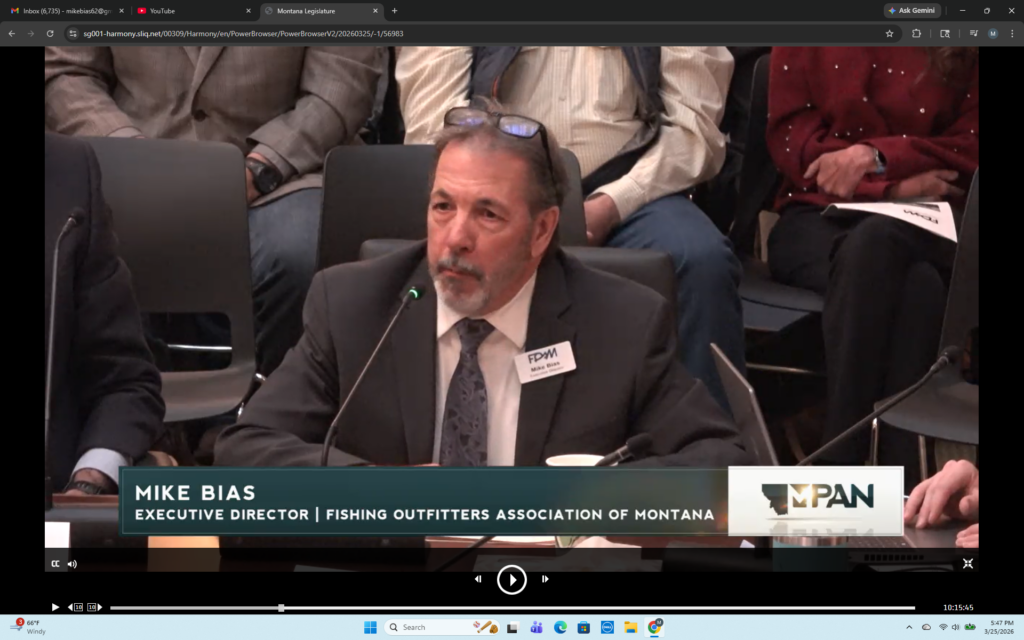
Mike Bias, executive director of the Fishing Outfitters Association of Montana, said there are misconceptions about how many outfitters and guides are sharing rivers with recreationists. The percentage is small, he told the council.

(FOAM encourages all of you to watch the EQC meeting. You could watch all the panels.  As you’ll see what FWP and us are up against.  Certainly, if you only watch the River Rec Panel, you will see what we’re up against, as although the panel was to discuss river recreation, it quickly centered solely on commercial use.
 
 
The Recreation panel starts at 9:48:00; Dr. Bias testimony starts at 10:15:31; Worth the watch.)
 

Bias was a member Wednesday of the river recreation panel, along with Randy Arnold, Director of Lands, Culture, and Recreation for Missoula County and a former outfitter and employee of Montana Fish, Wildlife and Parks, and Charlie Sperry, a fishing outfitter who worked for FWP for 22 years developing policies and plans for recreation and outfitting on Montana’s rivers.

Another member was Steve Luebeck, board treasurer for the Big Hole Watershed Committee and a director for the George Grant Chapter of Trout Unlimited.

Luebeck, who has been involved in numerous river management efforts, said commercial use is increasing and that limits on commercial outfitting on rivers is commonplace in the West, but not in Montana, though there are limits on the Big Hole and Beaverhead rivers and permits required on other rivers.

“If Montana fails to enact commercial use limits on major rivers, similar to all other Western states, this problem will only increase,” Luebeck said.

Sperry said the state has created citizen advisory councils in the past to advise about rivers and recreational use and then ignored their input.

“A lot of these recommendations just sat there,” he said, a situation he described as heartbreaking. 

He said these citizens groups often wanted data about river use that wasn’t available.

Sperry said FWP needs more employees and money to gather data and address river crowding and related social conflicts.

“How do we manage use on these rivers?” he said.

The EQC has oversight duties for the Department of Environmental Quality, FWP and the Department of Natural Resources and Conservation.

The EQC’s personnel includes a dozen appointed legislative members, both Republicans and Democrats, and four public members.

Rep. Paul Fielder, R-Thompson Falls, a retired wildlife biologist, is chairman.  Rep. Tom France, D-Missoula, opened the discussion.

“I think we all, as members of the Legislature, understand that rivers embody so much of Montana,” he said. “They make movies about our rivers. Now they’re making television shows about our rivers. And in my five decades in the state, the attachment and use of our rivers has grown and continues to grow.”

France said the challenges facing the state’s rivers are “almost less about the rivers themselves and how we interact and how we use those rivers.”

Montana River Health

Mike Duncan, Region 3 fisheries manager for FWP, served on the river health panel.

He referenced well-publicized population declines of trout in the Big Hole, Beaverhead and Ruby rivers over the last several years and efforts, such as tributary reconnections, to bring more cold water to the river.

Duncan mentioned discussions through the years of rebuilding the Pattengail Dam to create a reservoir to release summer flows. The original dam failed in 1927, flooding Wise River and causing four deaths.

He acknowledged that even if such a dam and reservoir made it through the permitting process, the cost would likely be prohibitive.

“We don’t have much influence over the water in a meaningful way that will affect these fisheries, but there are tools, with the support of the [Fish and Wildlife] Commission, where we can enact angling regulations, gear restrictions and that kind of thing, and maybe influence the fisheries,” Duncan said.

In low-flow years on the Big Hole and other rivers in the Jefferson River Basin, tensions between irrigators and fishing industry businesses regularly surface. The summer of 2026 seems destined to repeat that scenario.

Nathan Cook is an environmental scientist with the state’s Natural Resource Damage Program. NRDP, funded by a settlement with Atlantic Richfield, works to restore or replace natural resources and support outdoors recreation lost to historic mining and smelting pollution.

Cook’s work has focused, in large part, on the Clark Fork River, first as a fisheries biologist for FWP and then as an NRDP staff member.  

Nathan Cook with the state Natural Resource Damage Program spoke Wednesday about the health of Montana fisheries during a meeting of the Environmental Quality Council.

His presentation to the EQC focused on a plunge in the brown trout population in the upper Clark Fork River near its headwaters.

Cook said multi-disciplinary research continues to try to understand the causes, which might be interactive. Superfund cleanup work continues downstream, closer to Deer Lodge.

He said the designs for streambanks have been refined as the work has proceeded. In part, the changes are designed to recreate fish-friendly habitat more quickly.

The panel focused on nutrients pollution began with Lindsey Krywaruchka of DEQ.

She spoke positively about the agency’s switch to narrative standards for water quality from numeric standards, saying the narrative approach ultimately would yield more healthy water for ranchers and for drinking.

Meanwhile, Senate Minority Leader Pat Flowers, D-Belgrade, who is a former FWP employee, asked about a worst-case scenario after expressing appreciation for what he described as the agencies’ methodical and incremental approaches.

“My question is, is this fast enough, given the trend over the last 12 years, which is a steady decline in several rivers that you focused on, and climate projections for lower winter storage, longer, hotter and drier summers?” Flowers said. “Those expected climate change factors may move more quickly and overwhelm our methodical and incremental approach. If that’s the case, we could have, in my opinion, a complete collapse in our fisheries in several of those rivers over the next decade.”

This article was adapted from DUNCAN ADAMS duncan.adams@mtstandard.com Mar 30, 2026.